~50%
del daño en seguidores lo provoca el clima. La presión de precios ha llevado a algunos fabricantes a recortar el análisis de ingeniería, y las reclamaciones al seguro han crecido.
Un nodo compacto instalado detrás del plano del panel aporta visibilidad estructural directa a cada seguidor solar, sin sombrear los módulos.
Más energía. Menos riesgo. Menos mantenimiento.
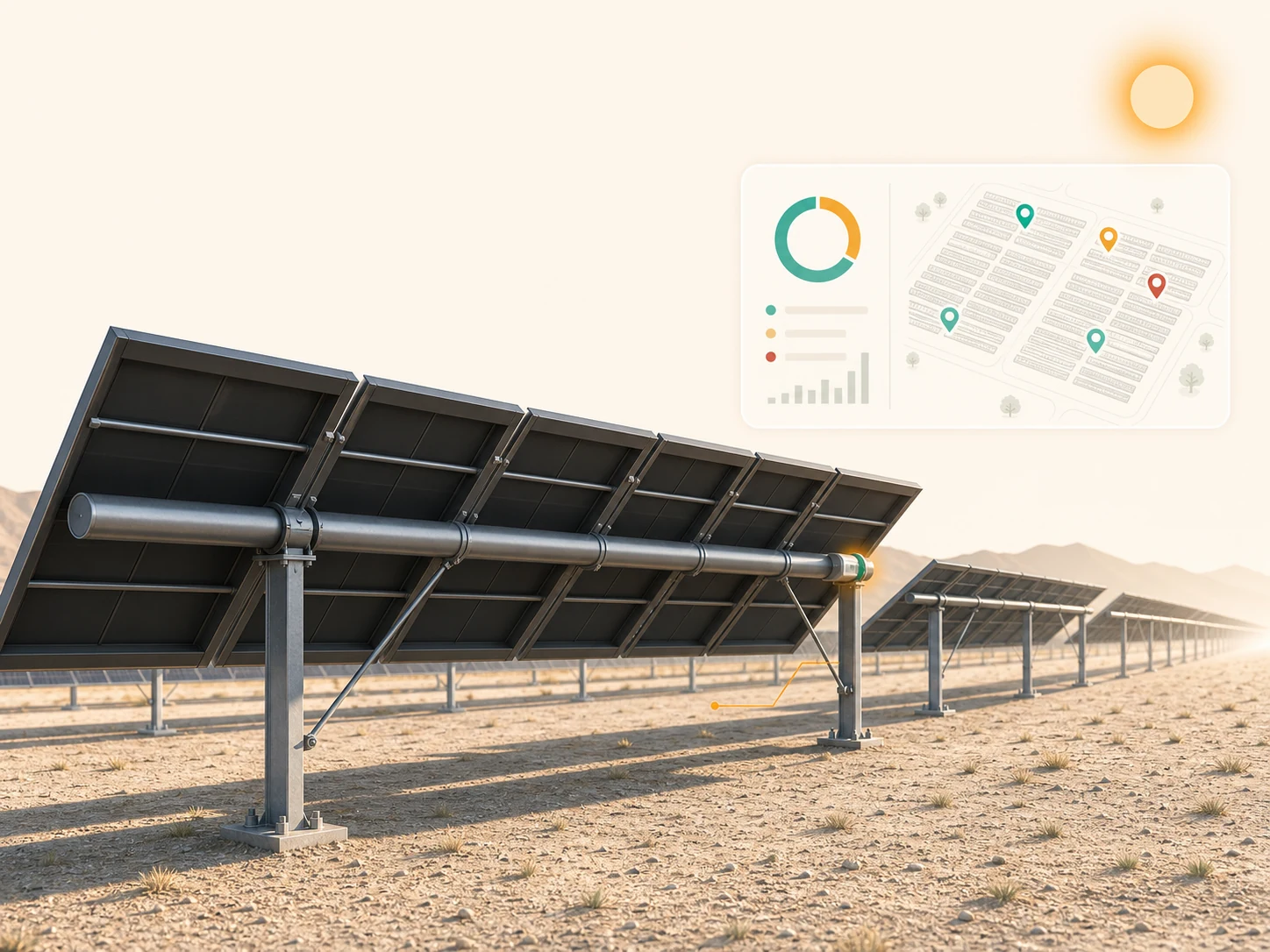
El concepto conecta sensado estructural directo, localización exacta sobre el mapa, mantenimiento predictivo y verificación independiente de stow en una única capa de bajo coste.
Resumen conceptual ilustrativo. Los beneficios potenciales son estimaciones que deben validarse con el operador durante el piloto.
Los seguidores de un eje elevan la producción entre un 25 y un 35 por ciento frente al panel fijo, por eso llevan casi toda la nueva potencia a escala de planta en España. Pero el seguidor es la pieza móvil, mecánica y expuesta de la planta, y los operadores apenas conocen el estado real de cada uno.
del daño en seguidores lo provoca el clima. La presión de precios ha llevado a algunos fabricantes a recortar el análisis de ingeniería, y las reclamaciones al seguro han crecido.
El viento por debajo de la velocidad de diseño puede provocar un galope torsional que retuerce el tubo de torque hasta romperlo. Es un destructor documentado de seguidores e invisible para el SCADA estándar.
Los operadores leen el inclinómetro del propio controlador del seguidor. Si ese sensor deriva, la fila apunta mal mientras informa de un ángulo correcto, y la producción se pierde en silencio.
En EE. UU., el granizo ha sido la mayor causa de pérdida asegurada solar, y la defensa frente al granizo y el viento es la posición de stow. Sin embargo, hoy nadie confirma de forma independiente que un seguidor concreto alcanzó su stow seguro. En una planta de más de diez mil seguidores, los fallos aún se detectan por caída de producción a posteriori o recorriendo las filas.
Una capa ligera de campo convierte el comportamiento del seguidor en información útil para mantenimiento, sin añadir complejidad visual a la planta.
Cada nodo mide la inclinación y vibración reales del seguidor y permanece detrás del plano del módulo.
Una red de bajo consumo reúne los veredictos de campo en un mapa de planta con pocos gateways.
La analítica prioriza la atención, revela patrones y ayuda a actuar antes de que una avería aumente.
El nodo reempaqueta el sensor LARA, la lógica en el borde reutiliza nuestra corrección térmica y detección de anomalías, y el panel reutiliza nuestro gemelo digital BIM. Hay poco que inventar, por eso es rápido y de bajo riesgo.
Captación solar con almacenamiento tolerante al calor, sensado MEMS de bajo coste fusionado de la tecnología LARA, un cerebro en el borde con corrección térmica y chequeo de anomalías, e independencia del sensor del accionamiento.
Un gateway LoRaWAN cubre miles de nodos, un servidor en el borde gestiona la sincronización horaria y la agregación de alarmas, el retorno es NB-IoT o LTE-M con respaldo satelital, y el firmware va cifrado y firmado, alineado con NIS2 de la UE.
Un gemelo BIM y GIS liga cada nodo a su ID y ubicación de seguidor, un modelo de flota marca los atípicos que un nodo no ve solo, un mapa convierte las alertas en órdenes de trabajo, y una interfaz en lenguaje natural responde preguntas sencillas.
Arrastre para orbitar el seguidor. Elija un escenario para inyectar un fallo y observe cómo el nodo detecta la diferencia entre la inclinación real medida y el ángulo solar esperado, junto con la traza de vibración.
El nodo ejecuta esta lógica en el borde y solo envía el veredicto, así una planta de 13.724 seguidores cabe en unos pocos gateways LoRaWAN.
Los MEMS de bajo coste son excelentes con el movimiento grueso y los fallos por viento, buenos con la holgura y débiles con el desgaste fino de rodamiento. TrackerGuard vende detección de anomalías y garantía de apuntamiento, no magia.
| Qué mide el nodo | Fallo que revela | Confianza |
|---|---|---|
| Inclinación real frente al ángulo solar esperado | Fila bloqueada, deriva, descalibración, fallo de stow | Alta |
| Vibración en tres ejes durante el viento | Galope torsional por viento e inestabilidad | Alta |
| Movimiento durante una orden de giro | Motor muerto, atasco, driver quemado, batería agotada | Alta |
| Ángulo frente a tiempo durante la inversión | Holgura y juego mecánico | Media |
TrackerGuard no solo mide. Convierte la señal estructural en decisiones.
Qué seguidores presentan riesgo de fallo.
La causa probable de una anomalía.
Verificando la posición de seguridad frente a viento y granizo.
La producción y el mantenimiento de toda la planta.
El mercado es fuerte controlando seguidores y fotografiando módulos, pero todo enfoque actual es ciego al estado mecánico real de cada seguidor. Ese punto ciego es la oportunidad.
Nextracker, Array y Soltec son fuertes en producción y stow por viento, usando el inclinómetro propio del seguidor y un anemómetro compartido. El punto ciego. Confía en el sensor del propio accionamiento, es propietario de esa marca, y los seguidores pasivos no llevan telemetría estructural alguna.
Raptor Maps y similares vuelan drones térmicos para hallar puntos calientes de módulos y conectores defectuosos. El punto ciego. Es periódica, no continua, y ve fallos eléctricos y de módulo, no el movimiento mecánico, la vibración ni el galope.
El software de planta marca seguidores cuyo ángulo ordenado se desvía de la flota. El punto ciego. Razona sobre el ángulo ordenado o informado, así un sensor de controlador que deriva queda invisible y la estructura nunca se mide.
| Capacidad | Control OEM | Escaneo aéreo | SCADA | TrackerGuard |
|---|---|---|---|---|
| Independiente del sensor del accionamiento | No | Sí | No | Sí |
| Vibración y galope continuos | No | No | No | Sí |
| Inclinación real por seguidor | Parcial | No | No | Sí |
| Funciona entre marcas, retrofit | No | Sí | Parcial | Sí |
| Coste de instrumentar cada seguidor | Alto | Medio | Bajo | Bajo |
El nodo es el punto de partida. Cada planta también necesita una capa operativa dimensionada para su geometría, red y proceso de mantenimiento.
Asocie cada nodo a su seguidor exacto para que el equipo de mantenimiento sepa dónde intervenir.
Planifique gateways, puesta en marcha y cobertura alrededor del diseño real de la planta.
Revise la evolución de los seguidores, priorice anomalías y apoye la planificación con evidencia.
El precio del hardware contempla el producto industrial alrededor de la electrónica: caja, certificación, revisión de calidad, soporte y un margen sostenible.
Una señal estructural común apoya la operación diaria, la investigación de fallos y la visión a largo plazo de la flota de seguidores.
Compruebe si el ángulo real del seguidor coincide con el valor esperado.
Verifique que los seguidores alcanzan su posición de protección frente al viento.
Identifique cambios de vibración y anomalías repetidas antes de que se conviertan en fallos costosos.
Envíe a los técnicos al seguidor que requiere atención, no a una zona de búsqueda amplia.
Use mediciones de campo para comprender la exposición a fatiga de la flota.
Cree una capa de datos práctica para inteligencia operativa y análisis futuros.
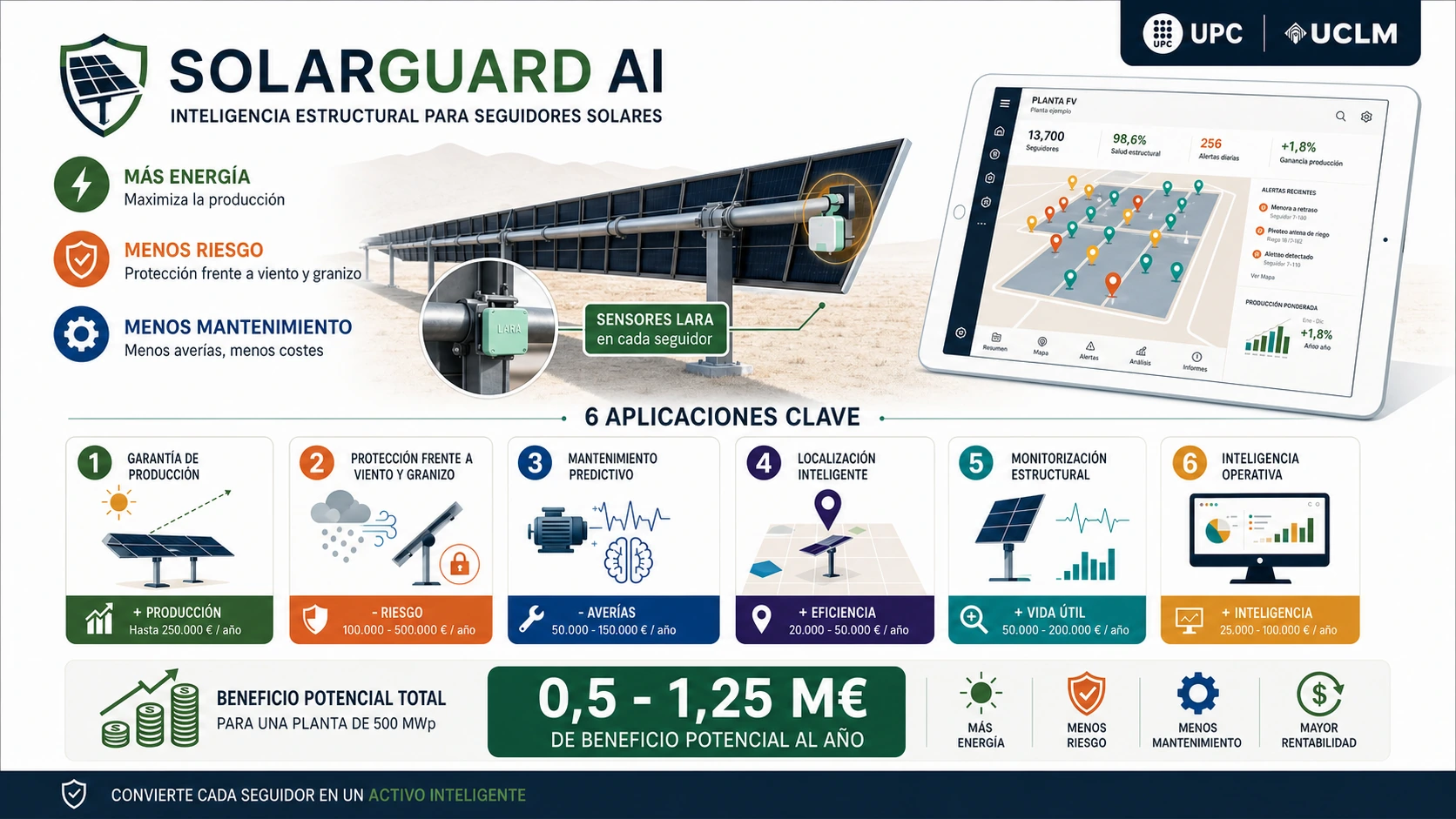
Beneficio anual potencial total para una planta de referencia de unos 500 MWp. Es un rango estimado, no una cifra garantizada ni acumulable, y debe validarse con el operador.
TrackerGuard traslada activos de sensado existentes a un nuevo uso práctico para las grandes plantas de seguidores y la industria española del sector.
La fusión de sensores MEMS LARA y la corrección Thermo-InclinoCal son activos existentes, ya en TRL 5 a 6 sobre estructuras reales. La lógica de fallos de seguidores y la capa de servicios de planta amplían esa base.
Una colaboración de investigación UPC y UCLM que une sensado de bajo coste, IA, ingeniería estructural y gemelos digitales.



TrackerGuard es un concepto de investigación de UPC y UCLM con una ruta práctica de despliegue. Un piloto permitiría validar instalación, conectividad, comportamiento en campo y modelo de servicio con un operador real.
Las cifras de plantas y mercado usan fuentes públicas. La base de sensores convencionales procede de nuestra propuesta interna SAMPIAS. El precio TrackerGuard es un objetivo de venta pública a volumen de flota, sin IVA.
TrackerGuard es un concepto de investigación de UPC y UCLM en desarrollo. La demostración 3D es un modelo ilustrativo, no datos reales de campo. Las cifras de coste, rendimiento y detección son objetivos y estimaciones, no garantías. Un piloto en planta es el siguiente paso.